
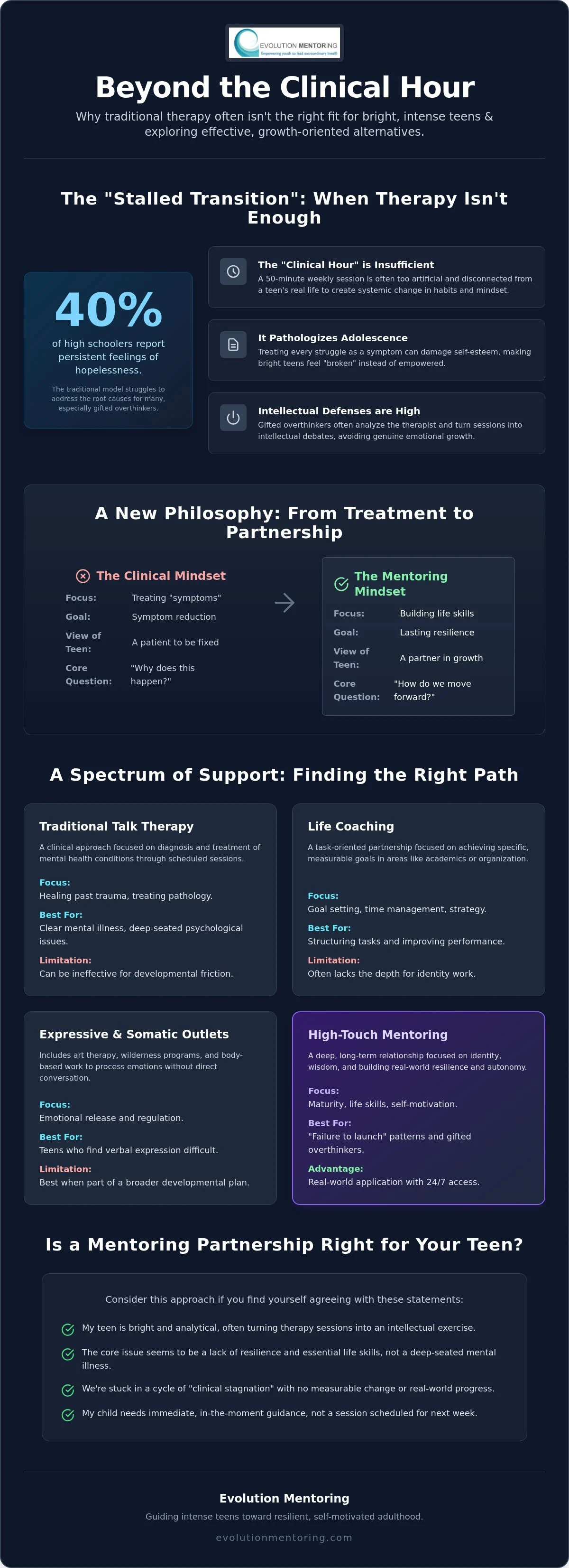
What if the reason your bright, intense teenager is resisting therapy isn’t because they’re “difficult,” but because the clinical model itself feels like a cage? You’ve likely noticed that for a gifted overthinker, being “pathologized” in a doctor’s office only deepens their sense of being broken. With 40% of high schoolers now reporting persistent feelings of hopelessness, the search for effective alternatives to therapy for teens has never been more urgent for families who feel stuck in a cycle of clinical stagnation.
You want a child who is resilient and self-motivated, not one who views their personality as a list of symptoms to be managed. It’s time to stop treating adolescence like a disease and start looking at it as a high-stakes transition that requires a different kind of map. This guide will show you how to move beyond the one-hour weekly session toward a growth-oriented path that builds genuine autonomy. We’ll explore how shifting from a “treatment” mindset to a mentoring partnership can finally resolve the “failure to launch” fears and restore the health of your family dynamics.
Key Takeaways
- Understand why the traditional “clinical hour” often fails to create systemic change for gifted overthinkers who require more than a weekly 50-minute session.
- Explore a range of alternatives to therapy for teens that prioritize developmental growth and real-world autonomy over clinical diagnosis.
- Adopt the “Adolescence Is Not A Disease” philosophy to shift your family dynamic from one of “treatment” to one of intentional partnership.
- Discover why a high-touch, six-month mentoring model is more effective at building lasting resilience and preventing “failure to launch” patterns.
When Traditional Talk Therapy Isn’t the Right Fit for Your Teenager
Many parents find themselves in a frustrating loop: their child is clearly struggling, yet three months of weekly sessions have yielded no measurable change. This is often what we call the “stalled transition.” Your teenager isn’t necessarily mentally ill; they’re simply ill-equipped for the complexities of modern adulthood. For a gifted overthinker, the traditional 50-minute “clinical hour” feels insufficient and artificial. It lacks the systemic reach needed to change daily habits and often fails to provide the real-world application these intense kids crave. When we treat every struggle as a pathology, we inadvertently tell bright kids they’re “broken.” This medical model can damage self-esteem by framing their natural intensity as a symptom to be managed rather than a power to be harnessed.
The Gifted Overthinker and the Therapy Trap
Highly intelligent teenagers are experts at intellectualizing their problems. They don’t just attend sessions; they analyze the practitioner, turning personal growth into a debate they intend to win. In high-pressure environments like Marin County or Beverly Hills, this intensity is often dialed to the maximum, leading to a profound sense of isolation. These teens don’t need a diagnosis. They need a partner who can see through their sophisticated defenses and challenge them to move from abstract thought into concrete action.
Distinguishing Between Mental Illness and Developmental Friction
Clinical psychotherapy is vital for treating trauma or deep-seated pathology. However, when the issue is a lack of resilience or life skills, looking for alternatives to therapy for teens, such as Wilderness Therapy or high-touch mentoring, is often more effective. Developmental friction is the natural tension between a teen’s growing need for autonomy and their lack of essential life skills. While a clinician focuses on “why” a behavior exists, a mentor focuses on “how” to build the maturity required to move past it. If your family is ready to pivot toward a growth-oriented path, you can schedule a consultation to discuss how to break the cycle of clinical stagnation.
Comparing Alternatives to Therapy for Teens: Mentoring, Coaching, and Beyond
Identifying the right fit for a bright, intense teenager involves looking beyond the medical model. We can categorize the most effective alternatives to therapy for teens into three distinct frameworks: clinical skill-building, expressive outlets, and developmental partnerships. Clinical options like DBT focus on symptom reduction and regulation. Expressive outlets, including art or wilderness programs, prioritize emotional release. Developmental models, however, focus on the maturity and wisdom required for a successful transition to adulthood.
A high-touch mentoring model moves support out of the artificial office setting and into the real world. It provides the application and 24/7 access that traditional settings lack. When your child faces a social crisis or a moment of deep self-doubt on a Friday night, they need immediate guidance, not a session scheduled for next Tuesday. This approach addresses the “life skills” gap, fostering resilience and social intelligence in the moments they actually occur. It’s about developing the agency to navigate life’s complexities with a sense of mastery.
Mentoring vs. Life Coaching: What’s the Difference?
Mentoring is a deep, long-term relationship centered on identity and wisdom. Life coaching is often more task-oriented, focusing on specific goals like academic organization or time management. Evolution Mentoring and Life Coaching bridges these two disciplines by providing expert guidance tailored specifically to intense personalities who require both strategic coaching and a meaningful connection. Mentoring for youth is recognized as a powerful tool for fostering positive developmental outcomes. If you’re unsure which path fits your child’s profile, you might schedule a consultation to explore the nuances of their specific needs.
Creative and Somatic Alternatives
For teens who find verbal expression difficult, art programs or somatic healing provide a necessary outlet. These methods allow for the processing of internal tension without the pressure of direct conversation. While helpful for emotional regulation, they often lack the structured growth and strategic maturity built through a professional mentoring relationship. They work best when integrated into a broader developmental plan.
Parental Selection Checklist
To determine which alternative matches your teen’s intellectual and emotional profile, consider these four factors:
- Intellectual Engagement: Does your teen require a logical framework and a clear “why” before they’ll commit to a plan?
- Intensity Level: Is the struggle rooted in high-octane overthinking that bypasses traditional talk?
- Goal Orientation: Are you solving for a clinical diagnosis or a lack of developmental maturity? For families navigating a disconnect between high ability and low follow-through, coaching for bright underachieving teens offers a targeted framework for bridging that gap.
- Support Frequency: Does the situation require a consistent, high-touch presence rather than a weekly check-in?
Evolution Mentoring and Life Coaching: A Growth-Oriented Path to Resilience
Success for a gifted, intense adolescent often requires a complete departure from the medical model. At Evolution Mentoring and Life Coaching, we work from the foundational belief that “Adolescence Is Not A Disease.” Instead of treating personality traits as symptoms, we focus on the untapped potential within these bright individuals. Jeff Leiken leverages 30 years of experience across four continents to serve as a linguistic translator, helping parents and teens finally understand one another. This six-month intensive model provides the structure necessary for bright overthinkers to move beyond abstract analysis and into consistent, purposeful action.
This high-touch approach is one of the most comprehensive alternatives to therapy for teens available today. Whether your family is located in the SF Bay Area, New York, or engaging virtually, the work is woven into the teen’s daily reality. We don’t wait for a weekly appointment to address challenges. By providing a steady, non-judgmental presence, we help teens navigate high-stakes social and academic pressures in real time. This ensures that the progress made isn’t just temporary, but becomes a permanent part of their character.
Building Essential Life Skills for the Modern World
Our focus remains on measurable developmental outcomes: social confidence, emotional regulation, and resolving the stagnation associated with “failure to launch.” We recognize that a teen doesn’t exist in a vacuum. The Parent Coaching Consultation is a critical component of our work, ensuring that the entire family system evolves in tandem. When parents and teens learn to communicate with clarity and intentionality, the path toward autonomy becomes a shared success rather than a source of conflict.
Taking the First Step Toward Lasting Change
Determining the right path forward is a significant decision that requires a clear understanding of your child’s unique profile. We utilize a consultative process to ensure a precise fit before beginning any intensive work. If you’re ready to move your family toward resilience and maturity, you can Schedule a consultation to see if Evolution Mentoring and Life Coaching is the right fit for your teen. This is the first step toward a future defined by autonomy rather than clinical management.
Charting a New Course for Your Teen’s Future
Finding the right path for a gifted, intense adolescent requires moving past the idea that they need to be “fixed.” We’ve explored how traditional clinical models can sometimes stall the transition to adulthood by focusing too heavily on diagnosis rather than development. By considering alternatives to therapy for teens, you’re choosing to prioritize your child’s autonomy and long-term resilience. Whether it’s through expressive outlets or a high-touch mentoring partnership, the goal is to shift the family dynamic from one of management to one of genuine growth.
Jeff Leiken brings 30 years of professional experience across four continents to his work with “gifted overthinkers” and their families. This 6-month intensive growth model provides the consistent support and strategic insight necessary to break through the “failure to launch” cycle. It’s about building the maturity and life skills your teen needs to navigate a complex world with confidence. If you’re ready to move beyond the clinical loop and see your child thrive, you can Schedule a Consultation with Jeff Leiken today. A brighter, more self-motivated future is within reach for your family.
Frequently Asked Questions
How do I know if my teen needs a therapist or a mentor?
You should seek a therapist if your child is experiencing acute clinical pathology, such as severe trauma or psychiatric symptoms that require medical intervention. Mentoring is the better choice when your teen is facing “developmental friction” or a stalled transition to adulthood. While a clinician focuses on the history of a wound, a mentor focuses on the strategy for future growth and the practical life skills required for autonomy.
What if my teenager refuses to attend therapy or coaching sessions?
Resistance is a common response when bright, intense teenagers feel they are being “pathologized” or treated like a problem to be solved. They often engage more readily with a mentor because the relationship is framed as a high-level partnership rather than a clinical treatment. When a teen understands that the work is about building their potential and agency rather than “fixing” them, their willingness to participate usually shifts significantly.
Is mentoring as effective as traditional clinical therapy for anxiety?
Mentoring is exceptionally effective for anxiety that stems from a lack of confidence or social competence. By focusing on real-world application and resilience, we help teens build a sense of mastery over their environment. This move toward competence naturally reduces the intensity of anxious thoughts. It’s one of the most proactive alternatives to therapy for teens who are tired of talking about their feelings and want to start changing their results.
How much does an intensive mentoring program typically cost?
The cost of an intensive program reflects the high-touch nature of the relationship and the depth of professional expertise provided. Premium mentoring models typically involve a long-term commitment because they offer 24/7 access and systemic support for the entire family. Unlike hourly clinical sessions, you’re investing in a comprehensive structural change that requires significant time and intentionality to internalize.
Can mentoring help with “failure to launch” in young adults?
Mentoring is specifically designed to resolve the failure to launch patterns often seen in gifted overthinkers. We address the root causes of stagnation by building the emotional regulation and executive functioning skills necessary for independence. By acting as a linguistic translator between parents and young adults, we help families establish the healthy boundaries and clear expectations required for a successful transition to adult life.
Do you offer virtual mentoring for families outside of the San Francisco Bay Area?
We provide comprehensive virtual mentoring for families across the globe, in addition to our local presence in the SF Bay Area and New York. Our virtual model maintains the same high-touch intensity and 24/7 access as our in-person engagements. Distance doesn’t limit our ability to provide effective alternatives to therapy for teens who require a sophisticated, growth-oriented partnership to reach their full potential. For families who have already explored traditional options without success, specialized coaching for bright underachieving teens can provide the targeted developmental support that finally moves the needle.