
The most exhausting role a parent can play is that of the “unpaid manager” for a child who has the potential but lacks the momentum to move forward. You’ve likely watched your gifted child stall after graduation, paralyzed by overthinking or a simple lack of direction, while you’ve stepped in to bridge the gap. This dynamic is unsustainable; it drains your energy and strains the family bond. Finding the right mentor for young adults is the strategic shift required to move from constant intervention to a professional partnership that fosters genuine growth.
You recognize that your child needs a bridge between their current stagnation and the independent success they’re capable of achieving. This article will help you navigate the complex landscape of modern support models to find the specific professional match that fosters lasting autonomy. We’ll compare different approaches to mentoring and coaching, showing you how to move from being your child’s manager to being their parent again. By understanding these models, you can help your child build the resilience and life skills that stick, ensuring their transition to adulthood is grounded in reality rather than just potential.
Key Takeaways
- Learn how to transition from “parent-as-manager” to a supportive observer by identifying a strategic partner who facilitates genuine adult autonomy.
- Compare the effectiveness of different support tiers to determine if a community volunteer, a general life coach, or a high-touch mentor for young adults is the right fit for your child’s specific needs.
- Identify why modern challenges like digital saturation and social anxiety require a rhythmic, high-frequency engagement rather than the standard, low-impact weekly session.
- Move beyond clinical labels by embracing a philosophy that views stalled transitions as developmental hurdles rather than diseases to be cured.
- Establish a clear, six-month path toward independent success that replaces parental enforcement with a professional partnership built on accountability and resilient life skills.
The Evolving Role of a Mentor for Young Adults in 2026
The transition to adulthood has become a gauntlet of digital noise and unprecedented performance pressure. Finding a competent mentor for young adults is no longer a luxury; it’s a structural necessity for families dealing with a stalled launch. While the traditional definition of youth mentoring often focuses on general encouragement, modern challenges demand a more rigorous, execution-oriented partnership. This role is less about being a “big brother” and more about acting as a strategic partner in the transition to independence. Parents often find themselves trapped in a cycle of enforcing basic adult responsibilities, which creates friction and delays maturity. A professional mentor breaks this cycle by providing a neutral, authoritative voice that shifts the focus from compliance to autonomy.
Why ‘Bright but Stuck’ Requires a Different Approach
There is often a significant gap between intellectual potential and executive function. Bright, sensitive young adults are frequently paralyzed by their own intelligence; they overthink every entry-level professional or social step until the cost of failure feels too high to attempt. This isn’t a lack of ability, but a lack of momentum. Coaching for young adults finding direction serves as the structural bridge that converts intellectual potential into real-world momentum for bright, sensitive young adults.
Mentoring as an Alternative to Clinical Psychotherapy
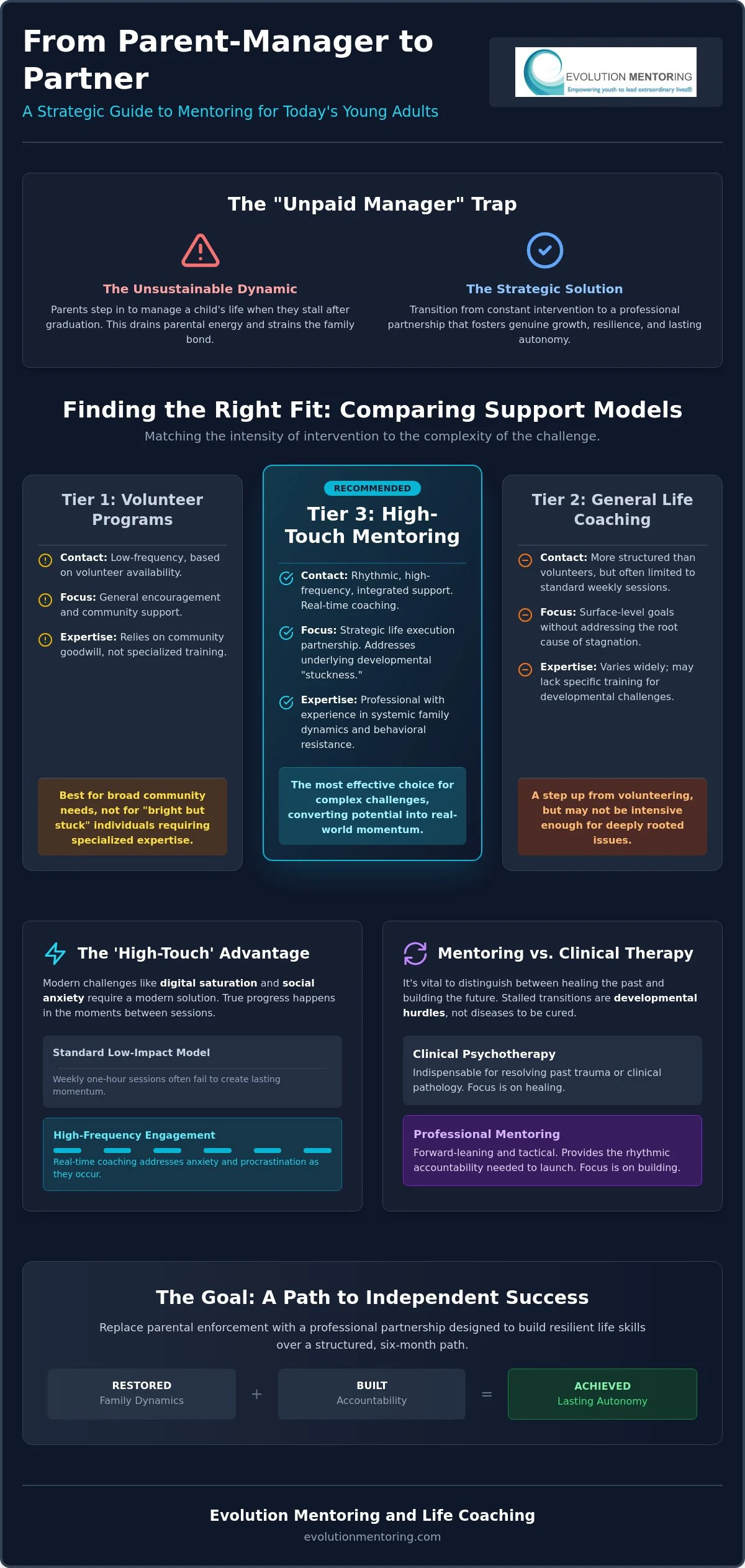
It’s vital to distinguish between healing the past and building the future. Traditional therapy is indispensable for resolving trauma or clinical pathology, but it often lacks the forward-leaning, tactical focus required for a successful launch. When a young adult is physically healthy but socially or professionally stagnant, a mentor for young adults is the more effective choice. If you’re ready to move from diagnosis to action, you can schedule a consultation to explore a growth-oriented path forward. Mentoring provides the rhythmic accountability that therapy sessions, often limited to fifty minutes a week, simply cannot match.
Comparing Mentoring Models: Finding the Right Fit
Selecting a mentor for young adults requires more than just finding a “good influence.” It’s about matching the intensity of the intervention to the complexity of the challenge. While the general Benefits of Mentoring include improved self-esteem and graduation rates, these broad metrics often fail to capture the nuances of a bright young adult who has stalled despite having every advantage. You must choose between three distinct tiers: volunteer programs, general life coaching, and high-touch professional mentoring.
Volunteer models rely on community goodwill and typically offer low-frequency contact. General life coaching provides more structure but often focuses on surface-level goals without addressing the underlying developmental “stuckness.” In contrast, high-touch professional mentoring is a strategic life execution partnership. It replaces the standard, weekly one-hour session with integrated, high-frequency support that meets the young adult where they are. This shift in frequency is what allows for real-time behavioral change.
Volunteer Programs vs. Professional Mentorship
Standard database programs are excellent for broad community support. However, intense or “bright but stuck” individuals often require specialized developmental expertise that a volunteer cannot provide. A professional mentor for young adults understands the systemic family dynamics at play and has the experience to navigate complex behavioral resistance. They aren’t just there to listen; they’re there to facilitate a structural change in how the young adult engages with the world.
The ‘High-Touch’ Advantage
True progress isn’t made in a vacuum; it happens in the moments between sessions. In high-pressure environments like Mill Valley or New York, the high-touch model provides real-time coaching that addresses anxiety or procrastination as it occurs. This model also shifts the burden away from the family. Instead of you being the enforcer, you can engage in parent coaching consultations to learn how to support their new autonomy without reclaiming the role of manager. This is the difference between a temporary fix and a permanent shift in family dynamics.
Implementing the Evolution Mentoring Framework
The philosophy at Evolution Mentoring and Life Coaching is rooted in a fundamental reframe: Adolescence Is Not A Disease. We don’t view a stalled transition as a pathology to be cured, but as a developmental hurdle that requires a specific set of tools to clear. This isn’t a quick fix; it’s a six-month commitment to a rhythmic process that replaces parental management with professional accountability. By establishing a consistent cadence, a mentor for young adults helps translate abstract goals into the daily habits required for independent living.
Resilience is built through the willingness to engage in difficult conversations and face the discomfort of real-world growth. While the primary focus is on the young adult, our framework includes Parent Coaching Consultations to ensure the home environment shifts in tandem. If parents continue to act as “managers,” the young adult’s newfound autonomy will likely struggle to take root. This systemic approach ensures that the entire family unit moves toward a more sustainable and respectful dynamic. For families who have already cycled through traditional clinical models without results, specialized coaching for young adults finding direction offers a fundamentally different architectural approach to building independence.
What to Expect in a Professional Mentoring Engagement
The engagement begins with a comprehensive assessment that goes beyond surface symptoms like lack of motivation or social anxiety. We look for the core developmental stall and then set specific milestones for career direction, financial literacy, and social resilience. This structured approach directly addresses the current crisis in youth mental health by providing the clarity and momentum that many bright individuals currently lack. When a young adult sees a clear path to mastery, their anxiety often gives way to purposeful action.
Taking the First Step Toward Independence
Initiating a conversation with a resistant child requires a shift from “telling” to “offering.” Presenting a mentor for young adults as a personal advisor or a strategic partner often reduces the defensiveness that traditional therapy might trigger. The process starts with a “chemistry” call to ensure the professional fit is strong enough to command respect and facilitate deep work. For families in the San Francisco Bay Area, New York, or Beverly Hills, you can schedule a consultation to begin the process of reclaiming your child’s future and independence.
Reclaiming the Path to Independence
Moving from the role of a primary manager to that of a supportive observer is a difficult but necessary evolution for any parent. We’ve explored how a professional mentor for young adults provides the rhythmic accountability and strategic execution that traditional models often lack. By focusing on the long game and building resilience through real-world challenges, your child can move past the developmental stall that has kept them from their potential.
Jeff Leiken brings 30 years of global mentoring experience to every engagement. As the author of ‘Adolescence Is Not A Disease’, he specializes in providing support for intense and gifted young adults who need a bridge between their high intelligence and their daily actions. This isn’t a quick fix or a clinical diagnosis; it’s a commitment to substantive, structural change in how your family functions and how your child engages with the world.
If you’re ready to replace constant enforcement with a professional partnership, you can Schedule a Strategic Consultation with Jeff Leiken. The transition to adulthood is complex, but with the right advisor, it’s entirely achievable.
Frequently Asked Questions
How is a mentor for young adults different from a life coach?
A mentor for young adults provides a more intensive, relationship-based partnership than a traditional life coach. While coaches often focus on discrete, surface-level goals like time management or career planning, a professional mentor addresses the underlying developmental stall. This role involves a high-touch, rhythmic engagement that integrates into the young adult’s life, rather than just a weekly check-in. It’s the difference between a tactical advisor and a strategic partner in the transition to autonomy.
What are the signs that my young adult child needs a professional mentor?
The primary indicator is a persistent gap between your child’s intellectual potential and their real-world action. If you’ve become the primary “manager” for basic adult responsibilities, the family dynamic is likely stalled. Other signs include severe overthinking that prevents career entry, social withdrawal, or a “bright but stuck” profile where the individual is paralyzed by the fear of failure. When traditional encouragement no longer moves the needle, a professional intervention is necessary.
Does mentoring work for young adults who are resistant to therapy?
Mentoring is often highly effective for those who reject the clinical nature of traditional psychotherapy. Because it focuses on building the future rather than healing the past, it feels less like a medical diagnosis and more like a high-level apprenticeship. This forward-leaning approach reduces the stigma for bright, intense young adults who don’t see themselves as broken. It reframes their struggle as a developmental hurdle rather than a psychiatric disease to be cured.
How long does a typical young adult mentoring program last?
A typical engagement follows a sustained, six-month path to ensure that new behaviors and life skills actually stick. Lasting transformation requires a rhythmic commitment that survives the initial burst of motivation and addresses the inevitable setbacks of real-world execution. Quick fixes rarely produce the resilience needed for independent success. This duration allows the mentor for young adults to build a deep, trusting relationship while gradually shifting accountability from the parents to the individual.